INNOVATION
How a Lab Breakthrough Could Reinvent Fertilizer
University of Buffalo scientists develop low-energy method that could decentralize fertilizer manufacturing
24 Jan 2025
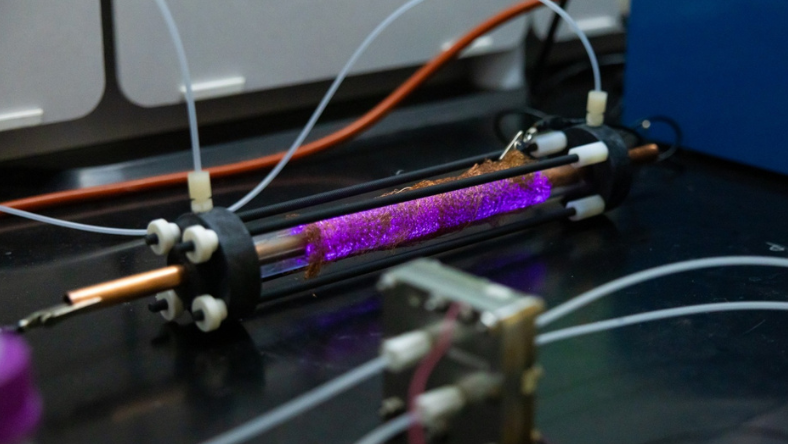
Researchers at the University at Buffalo have developed a low-energy method for producing ammonia, a key ingredient in fertilizer, that could challenge the industry’s reliance on large, emission-heavy factories.
The process replaces the Haber-Bosch method, in use for more than a century, which requires high heat, pressure and fossil fuels. Instead, the Buffalo team’s reactor synthesizes ammonia using only air, water and electricity, operating at room temperature without the need for large industrial infrastructure.
“This is about making fertilizer more sustainable and more accessible,” said Chris Li, assistant professor of chemistry and the project’s lead researcher. “It has the potential to empower producers at every scale.”
If scaled up, the technology could allow farms to produce fertilizer locally, reducing transport emissions and costs. It could also help small producers gain greater self-sufficiency at a time when the global fertilizer market is increasingly exposed to energy price swings and supply chain disruptions.
The breakthrough arrives as fertilizer producers face growing pressure to decarbonise. Companies such as CF Industries and Nutrien are investing in “green ammonia” projects powered by renewable hydrogen, while several start-ups are pursuing modular, low-emission systems.
The Buffalo reactor currently operates at a laboratory scale, producing small quantities of ammonia. Researchers say that with targeted investment and design improvements, the system could reach commercial levels of output suitable for agricultural use.
Global fertilizer production accounts for roughly 1 to 2 per cent of total carbon emissions, according to the International Energy Agency, mainly due to the energy intensity of existing methods. A transition to electricity-driven systems could significantly lower that figure, provided the power comes from renewable sources.
For now, Buffalo’s discovery remains an early-stage innovation. But it signals a potential shift toward decentralised, low-emission fertilizer manufacturing, one that could reshape the economics and environmental impact of global agriculture.
Latest News
12 Dec 2025
When Fertilizer Comes From the Barn, Not the Plant11 Dec 2025
Are Rising Fertilizer Costs Here to Stay?10 Dec 2025
Digital Farming? Fertilizer Industry Moves With Caution15 Apr 2025
Can Research Reinvent Fertilizer? DOE Invests $36M to Find Out
Related News

INNOVATION
12 Dec 2025
When Fertilizer Comes From the Barn, Not the Plant

MARKET TRENDS
11 Dec 2025
Are Rising Fertilizer Costs Here to Stay?
TECHNOLOGY
10 Dec 2025
Digital Farming? Fertilizer Industry Moves With Caution
SUBSCRIBE FOR UPDATES
By submitting, you agree to receive email communications from the event organizers, including upcoming promotions and discounted tickets, news, and access to related events.